
This essay was published in June, 2024 in Icelandic and in Swedish. Here, it is in English.
—————-
It is 27 degrees, high summer heat, this spring day late in May. I walk through Uppsala’s Botanical Garden on my way back to work from a demonstration against the war in Gaza. I’m trying to catch up with myself, before I have to step into my professional role and examine my students’ essays at the university. If nothing else can budge your illusions about the beauty of life, a several-minute reading of the names of innocent victims in Palestine and the terribly young age of the majority of them should shake you up.
————
My sister who lives in Iceland sent me a message the other day: “I’m packing as if I’m going to Tenerife”. She was coming to visit us and, as the family’s representative, attend my teenage daughter’s last concert in elementary school. The weather contrast between Sweden and Iceland is sharp. In Iceland, the trees haven’t even begun sprouting their leaves and the grass glows yellow in the background of the photos I get sent of my niece playing in the near-Arctic spring, dressed in warm and waterproof clothes, a beanie on her head and mittens on her hands.
In Sweden, the spring has been unusually warm, the vegetation explodes in splendor and when I take off my blazer in the shade of the trees in the Botanic Garden my senses are almost overwhelmed. The scent of lilacs in the air, the colours of all the blossoming branches of the trees so diverse that I lack the vocabulary to describe them. The green leaves contrast with the blue, cloudless sky, the shadows creep between the leaves as a slight breeze rustles the branches, and the birds chirp loudly about the boundaries of their territories.
Yellow tufts of grass and bare branches have been the colours of Iceland’s May – where the weather gods seem to have overslept and now must transform late winter into summer in a few short weeks and then, as usual, shut it down to start autumn early in August.
“Another day with 9 degrees and rain”. “I haven’t seen the sun for weeks”. Depressed, the Icelanders try to travel to the warmth of the sun. Even Sweden can be tempting when it’s “Tenerife weather” here, but in contrast to the abundance of May rain in Iceland, we haven’t had proper rain in Sweden for weeks. As my neighbour, the pensioner Leif, said when I mentioned Thursday morning’s small rain shower: “yes, we got 2 millimetres, it wasn’t any more than that”.
The ponds and ditches dry up, lakes become shallower. The tadpoles try to make their way in increasingly mud-like puddles and even the heron isn’t hungry in this heat, standing there in its skinny black and white colours, lacking only a cigarette in its beak to look like a heat-stricken Goth.
The weather is increasingly reminiscent of the summer of 2018, when it was so hot and so dry that there were irrigation bans and calls for water rationing in large parts of the country. In the evenings the sky would instil hope in us with its rumbling but the lightning only set fire to the dry ground; not a drop fell from the clouds. The whole of existence whispered heavily “please, just… rain. Please.” and got nothing but thunder in response.
We don’t even get that little bit of heavenly growling in Mälardalen now, and the municipality’s lawns, which are cut according to a schedule rather than need, have started to turn yellow. Sweden’s summer heat puts on the palette of Iceland’s spring as the greenery gives way to drought.
I’m trying to avoid the realization that it’s too hot for this time of year this far north; too hot is actually enough, no geographical qualifications are needed. And yet, we pretend that this is normal. Colleagues and neighbours talk about “enjoying it while it lasts” because “you never know if it will be good during the vacation” but behind the water cooler chatter hides the terrible realization that the papers’ jubilant headlines that “the high summer heat has come to stay!” should be read as the title of a horror movie. It’s not the height of summer now. It’s not even midsummer yet.
The climate disaster is ravaging everywhere but with different results and as usual we in the northern hemisphere get the mildest consequences. It’s hot here, but it’s closer to 50 degrees in several countries to the south. Excruciating heat, life-threatening, deadly heat. The discomfort we experience seems insignificant in comparison. In Sweden, it gets too hot and dry in May, too mosquito-ridden in June, and the ski-season gets shorter every winter. In Iceland, the spring and autumn storms become more frequent and increase in their strength, the summers get wetter and the winters greyer. In the Middle East, Asia and South America, however, people are boiling to death in the heat. Here we survive the weather despite everything. So far, anyway. And we contribute to the heat with our air travel and car journeys and frenzied consumption.
We?
I.
I will not hide my guilt in a plural “we”. Individuals also have a responsibility for the disasters and perhaps that is precisely why it can seem almost impossible to change anything. To slow down this development. To actually find a basis for faith in the future. The illusion that one should be able to consume ourselves from the climate is cracking like the dry patch of soil in my yellowing lawn. Can I appease my environmental conscience with a vegetarian diet, a hybrid car and blazers bought at a flea market? Ironing a patch onto the hole in my jeans, eating all the edges of the bread in the house rather than throwing them away and using reusable bags for the weekly grocery shopping is far from compensating for my trips to Iceland.
This self-deception is best illustrated by the fact that today it is far too hot to wear the blazer I bought at the flea market.
In Palestine the weather is not terribly hot at the moment, just a little warmer than here, so at least people aren’t dying from the heat there. At least not those who didn’t happen to be the object of missiles and “tactical attacks” and burned up in their tents or got crushed under the rubble of crumbling buildings. In Palestine, it is the political climate that kills people, an international political impotence and lack of demands hidden in false comparisons.
“The fire began because Hamas had placed fuel containers near the camp” Israeli politicians write, but if the Israeli military is to be able to target individual Hamas leaders with tactical missiles through keyholes on ancient doors, they must also be able to figure out where the fuel containers are in advance. They must be able to refrain from dropping their bombs right where the tent camps are located, filled with refugees from this vile war and their sleeping children. How can our politicians not protest against this ongoing disaster? How can they avoid seeing what is happening?
Many of them are probably as dumbfounded as I am in the face of horror. I retweet the outrage and despair on Twitter, put the Palestinian flag in my Instagram reel and share articles on Facebook. I visit the students’ demonstration and the Free University of Gaza tent camp – set up at the university library to remind that there are no Palestinian universities left in Gaza: they have been turned into rubble and their libraries set on fire. Again, individual but utterly impotent attempts to make a difference, for what individual actions or sharing on social media can challenge the world’s strongest armies with their lunatics barking orders for death and fire and more death? None at all, but the collectively, we might have a theoretical chance. That is why the demonstrations are so important.
————–
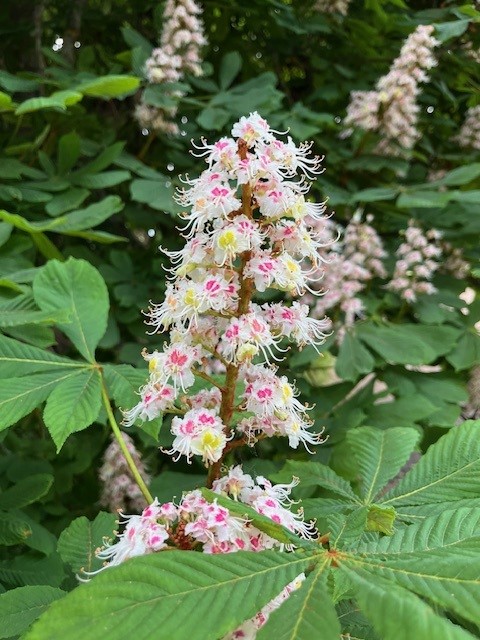
I step under the shade of one of the Botanical Garden’s chestnut trees and take a picture of its flowers. I breathe in all the scents of spring and try to block out the awareness of the ongoing disasters. A small attempt to capture my thoughts and lead them from the abhorrent to the everyday.
I still have the rhythmic cries of the demonstration in the palms of my hands, sore from keeping the beat:
“Uni, uni, you can’t hide! You’re supporting genocide!”
The doors of the university’s administration building have been locked since a demonstration took place there last week. Another impotent attempt to shut out the frightful, for the frightful is not the demonstrations but what they are trying to draw attention to.
“You’re supporting genocide“
By not taking an active position against what is happening, a passive position is taken in support of what is happening. The attempt to lock the doors to the challenge of the chants does not absolve the institution from its responsibility, but the attempt can be understandable on an individual level – these are also just a bunch of people who want to go to work and do their job and feel safe in their workplace. I am one of them, one of those who teaches, researches, writes chapters and articles, as if it were a sensible way to respond to a disaster-ravaged world without refuge. But that demand is directed at all of us: continue as if nothing has happened despite the ruthlessness of the devastation. We must live in the cognitive dissonance and act as if nothing is the matter.
————–
I walk through the park towards my workplace, which happens to be right next to the Botanical Garden. The students in there are waiting to discuss their essays and my task is to examine them today.
As if nothing has happened.
I must shake off my melancholy, defy the heat and put my blazer back; dress into on my profession, take on my professional role. I look again towards the blooming trees. With Uppsala’s pink palace in the background, this place suddenly seems unreasonably beautiful, like a place beyond time and space…
And there, by the wall closest to the castle,
the chestnut trees blossom.
As if nothing has happened.
 Gunnlaugur Magnússon